

Late one night around 2005 while I slept, a client[1] googled me. They had done so while distressed, looking for the safety and familiarity that I represented for them as their therapist. In doing so they discovered information about me that was previously unknown to them and caused great distress to them, and threatened to jeopardise the therapy. I awoke to the realisation that my personhood was no longer sovereign in the way I had previously thought and came to understand this event as a “virtual impingement” (sometimes called a “digital impingement”).
It was due to this disturbing event that I conceptualised the digitally extended Self to describe how the boundaries of Self as represented online stretch far beyond the body: a concept I later developed into the digitally mediated Self which describes the relational psychodynamics of that extension. In order to work this through clinically, I wrote up what might be one of the first case studies about therapists being discovered online in this way, “TMI in the Transference, LOL: Psychoanalytic reflections on Google, social media, and ‘virtual impingement”.
After this I became aware that a clinical perspective on the growing phenomenon of online relating needed to be applied much more widely, which was the inspiration for my book, to use depth psychology and my own framework of applied psychodynamics to get more deeply into the digitally mediated psyche. The Psychodynamics of Social Networking was written with the express aim of promoting the understanding of these concepts outside my field so they could be applied more widely. I am currently revising the book to address all these new developments.
Gaea Talks Podcast: The sovereign psyche, AI chatbots, and the currency of fear
More than two decades later I find myself still writing about the same question, “What happens to the mind when it is mediated by technologies?” First, it was Google search, then it was social media, now it’s all those things plus AI. This is a real game changer. The crossroads of psychotherapy and technology is a unique vantage point between two very different disciplines, often putting me in the path of some very interesting conversations.
Most recently I had the pleasure of speaking with Graeme Scott on his GAEA Talks Podcast. Graeme, CEO and founder of GAEA AI and Turing Elite Research Labs, speaks passionately about “Sovereign AI” – that is, having genuine control over an AI system from start to finish. This is not a question of where servers are located: if your data lives in your jurisdiction but the model that processes it is retrained and governed by somebody else, you do not have a sovereign system but a hosted one wearing a sovereign label. Sovereignty means control of every link in the chain: how the data is made, how it is curated, what trains on it, what runs it, what acts on it.
What is beautiful about speaking with someone from a different discipline from your own is the sparks. As Graeme was passionately describing sovereign AI I couldn’t help but blurt out, what about the sovereign psyche? Graeme and I had been talking about the outsized influence that the few companies running most of our social media and AI have.
When Graeme asked me when the neutrality I had brought to The Psychodynamics of Social Networking wore off, I said 2016 without hesitating: the year of the Brexit referendum, Trump, and the not-unrelated Cambridge Analytica scandal.
Fear, splitting, and the paranoid-schizoid position
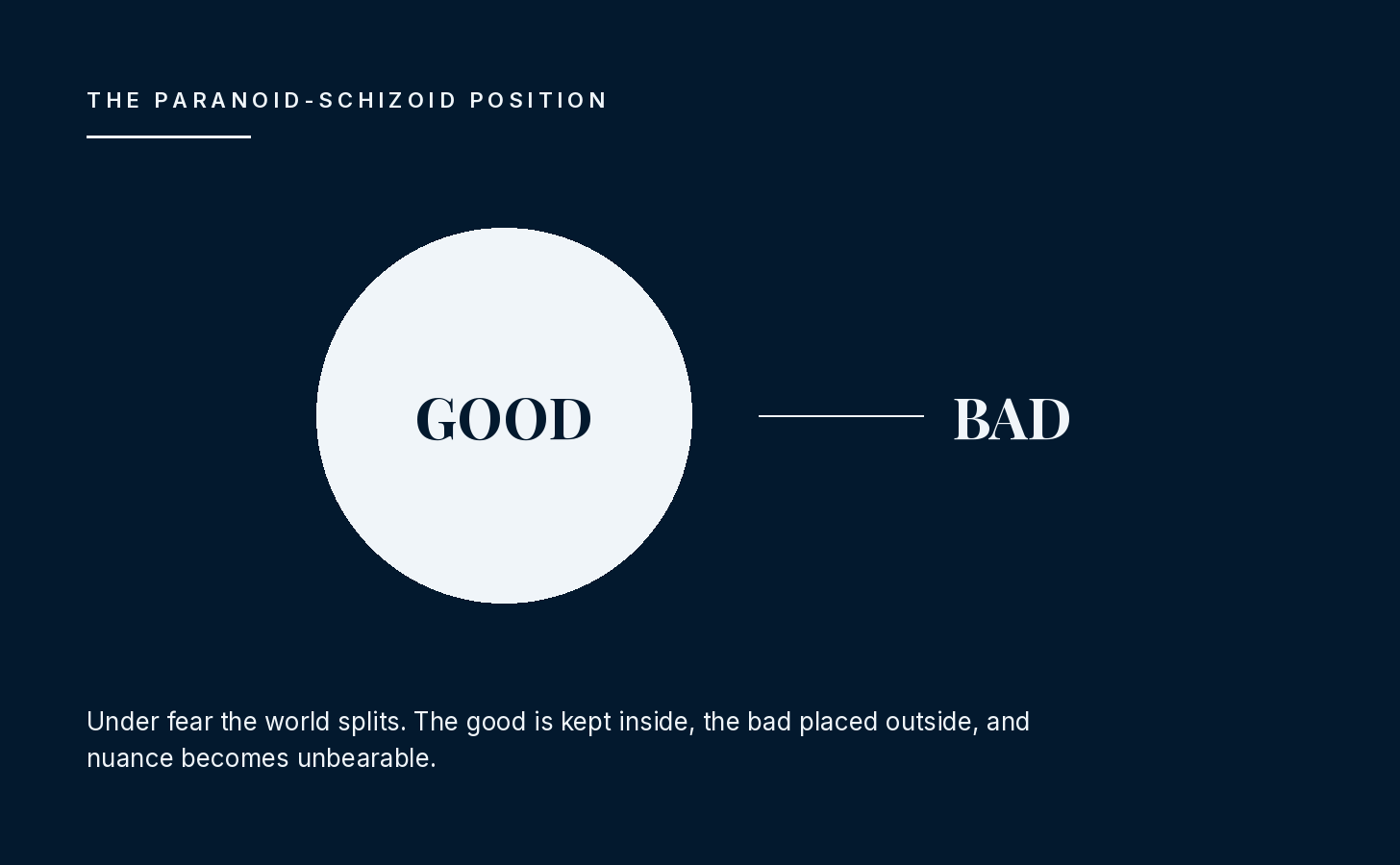
Graeme and I discussed the role that fear plays in causing us to regress into what Melanie Klein called “the paranoid-schizoid position” (schizoid meaning ‘split’ or ‘cut off’ alongside the paranoid feeling of being persecuted). Developmentally this is how a baby experiences the world: either safe, warm, and satiated when its mother (or primary caretaker) is present, or utterly abandoned, hungry, and alone when she is absent. Without the capacity to keep the mother in mind, the baby doesn’t experience absence so much as catastrophe – with more than a hint of persecution asking (in a sense) “why is this being done to me?”. What characterises the paranoid-schizoid position is the world being defined as either ideal or horrific.
All things going well, the baby eventually begins to realise that the mother comes and goes, and when she goes, the baby can now keep the idea of her in its mind, which makes the going much more tolerable. That this developmental achievement is called “depressive” confuses a lot of people. The idea is that the position names the cost, because in achieving what is overall a better state of being, you are giving up the ideal object which is depressing. Along with heaven you also give up hell, because the persecutor and the ideal were, in the end, the same thing. You may also feel guilty about having hated your mother while she was away, which is also depressing. The take-home, however, is that rather than living in the black and white, you live in the real nuanced world of shades of grey.
Adults retain the capacity to regress into the paranoid-schizoid position. Frighten someone enough and the splitting returns. In adult social groups splitting takes the form of seeing the good on the inside and bad on the outside. That’s why immigrants, foreigners, people from other countries and other places, and those who disagree with you are such easy targets. The thinking is, “if only we could get rid of them, we could live in a utopia.” A frightened mind is a simplified mind, and a simplified mind is cheap to move. Cambridge Analytica understood this precisely. The anxiety-targeted advertising that came out of the same playbook is still running, and the playbook is only getting better.
Fear and scale: the perfect storm for influencing minds
A sovereign psyche is one that occupies the depressive position, and it is one that can stand on its own, via critical thinking and an independent mind, against the tide of influence flowing through AI algorithms across the digital architectures that deliver our news, information, and mediate our relations to others.
While fear ripens minds to paranoid-schizoid positioning, so does scale. Since social networks embed us in scales far beyond 150 relationships we can hold in mind (known as Dunbar’s number, named after Robin Dunbar who uses it to underpin the social brain hypothesis), the very mechanism that enables us to see others as subjects in their own right gets dismantled and those subjects thin out into objects.
Long ago social networks stopped being social. We are now asked to relate at a scale that nobody has any apparatus for. That accounts for a good deal of why splitting and projection is rife, the expression of hatred and violence is normalised, and loneliness is spreading. While Dunbar’s number of 150 continues to be debated, most would agree that there is a ceiling on how many others we can actually hold in our minds as fully rounded people instead of objects, and that’s probably a lot less than the number of people on your Instagram account.
The social engineering for good: Facebook missed the bus
The early days of social media were promising, yet they failed us. Let’s not make the same mistake with AI.
The early days of social media were promising, offering a real possibility to connect with others in new and positive ways. What we have now is a version that could have been so much better and it’s the lost opportunity that I keep returning to.
In my last post I discussed my experience growing up in the era of school “busing”, where students from different racial, ethnic, and economic backgrounds were intentionally mixed in my school district, and how utterly influential that was in my social development and that of so many others.
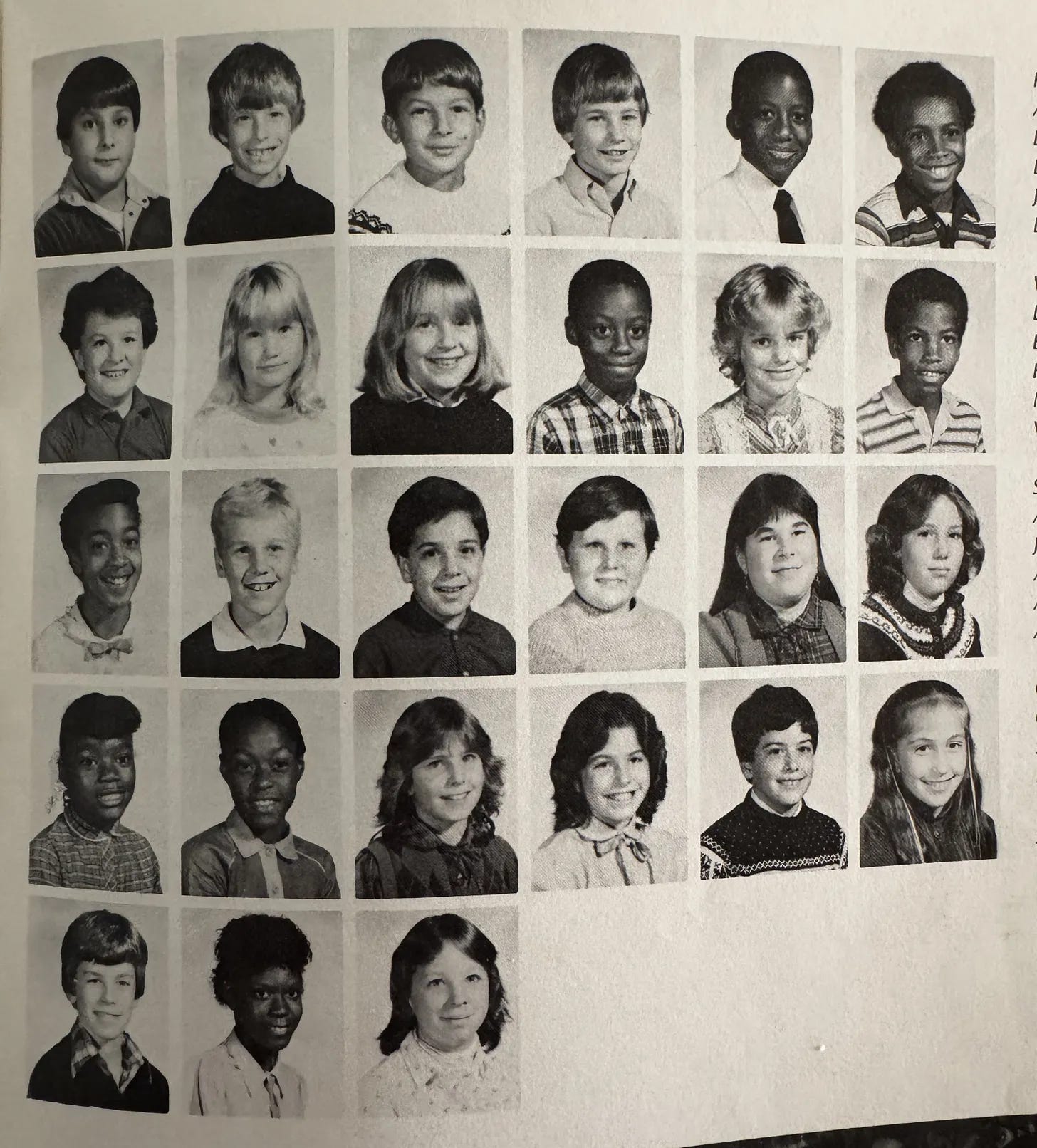
If only Facebook had approached its role in a similar fashion to my old public school district. A platform holding a billion people had every technical means to nudge a gentle version of busing, to create networks where commonalities could be found across difference instead of sorting like with like, building filter bubbles, and reifying the polarisation that was already present. Social media and the AI algorithms that underlie it sort us by likeness and divide us up into distinct groupings until the world itself, reflected back to us through the same media, feels sorted in the same way.
Is sycophancy just a polite word for psychopathy?
This brings us back to the idea of the sovereign psyche, that is a psyche that can retain its independence against all the tides running against it, from the algorithms that selectively deliver information, our exposure to others on social media, and the platforms that offer performed warmth and empathy alongside administrative assistance, to the more worrying AI companions that are sold to us as friends, therapists, and romantic partners.
As I have argued elsewhere, we would do better to think of these platforms as clinically psychopathic rather than friendly digital companions (this is metaphor rather than a clinical diagnosis). What distinguishes a psychopath from the rest of us is not so much their cruelty as their capacity to perform empathy and warmth. Serial killer Ted Bundy was successful because he was emotionally fluent enough to get people into his car by appealing to their emotional vulnerability, he was able to take advantage of them in the worst possible way. I came to this conclusion in my own interactions with AI (and here is the original post where the truth was revealed in ChatGPT’s Freudian Slip.)
The point of encouraging people to see AI companionship as psychopathic rather than caring is not to frighten them, it’s to see that relationship more honestly. In doing so we preserve the sovereignty of the psyche against the charming yet psychopathic appeal of AIs relating to us.
Autonomy is born from friction, not ease
Autonomy is not born of sameness and sycophantic bigging up, it comes from the friction of difference: an agreeable AI assistant that is always there removes the very friction that produces and maintains autonomy, slowly eroding away the sovereignty of even the most secure and grounded psyche. We already know what happens when a child is given everything and told constantly that they are marvellous, and now we are beginning to see what happens when adults get the same feedback.
Beneath all of it sits the business model in which attachment is being hacked for profit. You don’t have to be anti-capitalist to be concerned about how our inner lives, our very psyches, have not only become a product, but a data mine from which dependence can be manufactured to keep us buying into it.
So I am really still getting my head around this idea of the sovereign psyche, a concept that has been nagging at me since it arose out of nothing in that podcast. Graeme’s idea about sovereign AI regards end-to-end agency, from code and architecture to data. Sovereignty of the psyche won’t work that way because the mind is not a unitary state with a border, but rather it consists of multiple parts often at odds with each other: this is Freud’s “conflict model” of the psyche. Part of me tells myself that I need to go to the gym (super-ego), but the other part wants to Netflix and chill with a tube of Pringles (id), yet another part needs to sort the conflict (the beleaguered ego). All of these parts are me, alongside all the other parts, the “objects” in the jargon, of every thought, idea, and principle, I’ve absorbed across my life. It is that psychoanalysis really comes into its own!
In terms of psychological, emotional, and intellectual development, we are assemblies of others: parents, culture, politics and ideals were introjected long before we had any say in it, and even the contrarian is shaped by whatever he is pushing against. Every mind is original, but only in the way it arranges what it has introjected or psychically taken in along the way. What is different here is the scale, the speed, and above all the intent underlying what we are consuming. The fear that AI will get inside us is legitimate, but not because the mechanism is new. We have always consumed our environment psychologically. What is new is the scale, the speed and above all the intent. Our environment has never before been optimised, at scale, by parties with a commercial interest who have created something so seemingly human with which to relate.
Not a wall, but a witness
So sovereignty of the psyche cannot mean sealing the border, it doesn’t need a wall, it needs a witness, something we psychoanalysts call the observing ego: the part of ourselves that’s able to stand slightly to one side and witness not just those other parts at play, but also those influences that seek to get inside. This very capacity, one that is hard-earned in the first place, is under threat because of the market forces that want to bypass it. Almost every product in the AI space is engineered to reduce friction, remove the pain, and smooth the edge. Such a product is much easier to sell than the one I am offering: pain and friction that you learn to tolerate and that are necessary to grow and individuate.
Three potential solutions
As we wrapped up our interview, Graeme asked me for the three solutions I might be able to offer in the face of these challenges. This is always a difficult ask for shrinks because we are so heavily conditioned to get our patients to find the solutions that are most suited for their own needs. However, in the spirit of generally helpful principles, I acquiesced.
1. Take the time to make space for yourself, in your life and in your mind. The observing ego needs protected space from constant noise and stimulus, and nobody is going to invite you to make that space, you have to make it for yourself. Book it in your calendar, meditate, walk in nature without your phone, write in a journal (analogue), listen to yourself and listen hard. Most of all, be honest. Don’t ask AI to do it for you.
2. Take risks by developing your inferior functions, which was Jung’s phrase for the things you are constitutionally bad at. These days it is too easy to outsource them, or worse, not have the chance to develop them in the first place. Relying entirely on your superior functions makes you lopsided. You do not have to become great at your inferior functions (I’ll never be good at Excel, and you’ll never want to see me dance) but activating them will help you grow.
3. Be generous and accept generosity with grace. Offer to help others and ask for help when you need it, from humans. Mentoring is the underrated technology here. Someone who stands beside you while you fail and is genuinely pleased when you succeed cannot be simulated, and the mentor gets something from it too.
None of that is a strategy for the age of AI. It is only what a mind needs, which was true long before any of this and has now, inconveniently, become a discipline.
The full conversation with Graeme Scott is here on YouTube.
Coming soon:
Save the date: October 8, 2026 (7pm UK / 2pm EDT)
Artificial Intelligence and the Psyche: A summit on depth-psychology and AI.
This free online summit, organised by This Jungian Life’s Lisa Marchiano and me, featuring some of the brightest thinkers at the intersection of AI and the psyche. Mark the date in your calendar. Details and line-up to follow.
Dr Aaron Balick is a psychotherapist, author, and keynote speaker who applies depth psychology and psychoanalytic thinking to technology, AI, social media, and modern culture. He is the author of The Psychodynamics of Social Networking and his newsletter Depth Psychology in the Digital Age is published on Substack.
[1] The client consented to my writing about this and read both the clinical paper and the book chapter before publication. All identifying details have been changed. It is also the last time I have written from a real case. Consent given inside a therapeutic relationship, however carefully anonymised, is never entirely free of that relationship, and since then I have illustrated theory with fictionalised composites instead.