

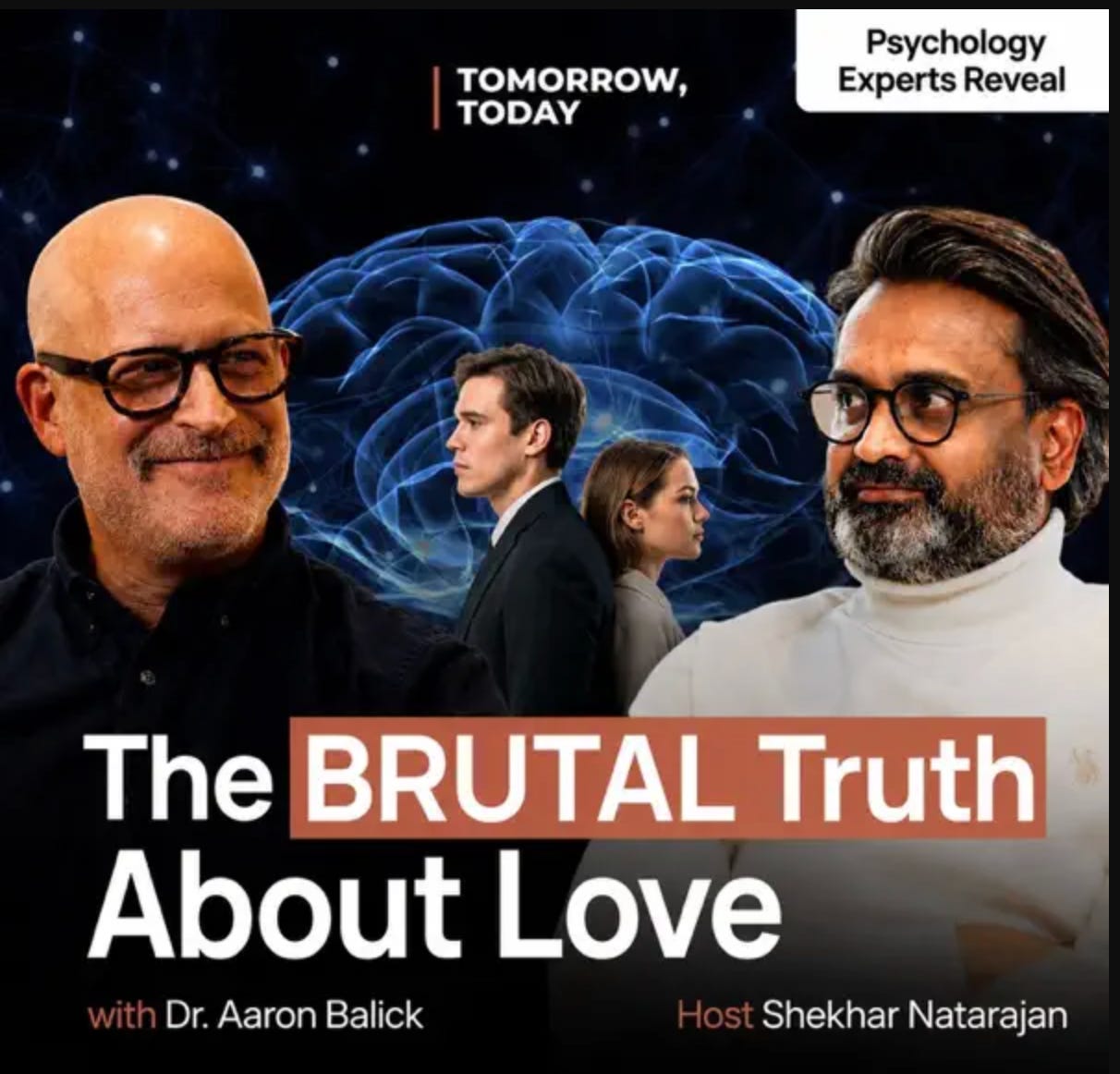
While getting myself ready for a podcast I accidentally shaved off my beard. The guard on my clippers slipped off, leaving a bald runway from ear to chin; I was left with little option but to equalise. I like my beard. It gives me, I tell myself, a certain gravitas. But now its grey and white remains littered my sink instead of adorning my face, and I arrived at the recording feeling rather exposed and faintly alien to myself. As it turned out, what I thought was already exposing was the warm-up act.
My interviewer was to be Shekhar Natarajan, CEO of Orchestro.AI, the mind behind Angelic Intelligence, and the host of the Tomorrow Today Podcast. From the start it became apparent that I was not going to appear as the usual pontificating expert; I was going to be the subject of a very personal interview.
I experienced a kind of vertigo in that reversal, and looking back, it surprises me just how unusual it felt to be the recipient of probing personal questions rather than being the one asking them. A therapist spends their working life as the one who asks and listens: the one whose own history mostly stays discreetly out of the room. But that asymmetry both holds the frame and serves as a protective and sometimes defensive position for the therapist.
To sit in the other chair, to be the one who is asked, gently yet persistently about oneself is to have the protection removed: as unsettling as that was, it served as an important reminder about the power of the asking role, however mutually negotiated those questions intend to be delivered. With the incisiveness of a journalist and the intuition of a psychoanalyst, Shekhar built trust in the room very quickly, and before I’d even quite realised it, I was talking freely about things I don’t usually narrate in public.

When Shekhar (beginning what would be a marathon two hours-plus interview) said that he wanted to start at the beginning, he wasn’t kidding. We started in Delaware, where I grew up, in a suburban normal so complete I described it as Edward Scissorhands territory: identical houses and trimmed lawns, a place seemingly engineered to communicate conventional middle-middle class largely (but not exclusively) white existence. But there was one thing standing in the way of my growing up so homogenised, something I hadn’t thought about in a long time, school bussing. I’ve long known that this experience had profound consequences on my life, but I’d never really discussed it with anyone, and certainly not publicly.
School bussing: the great social engineering experiment that went right
It surprised me that it even came up, but in trying to detail my early experience to Shekhar, it had to. Yet because I hadn’t prepared to talk about it, nor had I thought about it in so long, it all came across a little less eloquently than I would have liked - and there were some misunderstandings. So I wanted to write a little more about it here.
To make it very clear, I did not grow up in a racially segregated school district (I’m not that old). The schools, however, were essentially segregated due to their catchment areas being designed to receive students from relatively similar class and economic backgrounds. The legacy of slavery, racism, economic disenfranchisement of ethnic minorities, and the continued toll of institutional racism did the work of geographically divvying up the city and its suburbs that “official” segregation would have done.
Suburbs were mostly though not exclusively white and urban areas were mostly though not exclusively brown and black. Being on the giant East Coast conurbation that exists between New York City and Washington DC, there was a great deal of diversity representing ethnicities from across the world - but neighbourhood to neighbourhood you would see pockets of homogenisation. In 1978 (when I was five) school bussing began with the intention of undoing these hardened segregations and “integrate” the school districts, making schools perhaps the most multicultural and integrated spaces in the state.

In practice this meant children from different catchments were bussed to school to ensure a better ethnic, racial, and class mix. In elementary school I would board a traditional yellow school bus from my majority white neighbourhood into the urban centre which had become majority black. As it happens, I went to the very same school my mother went to when it was populated almost entirely by the white students who lived in the surrounding neighbourhoods at that time. In fact, you could see my grandmother’s house from my fourth-grade classroom window - one of the few remaining white occupants of a neighbourhood that had turned mostly black - I used to scream “GRANDMOM!” at the top of my lungs at recess, and she’d sometimes come out and wave hello from across the street.
I was too young to know anything about the politics of it all - bussing was simply my reality - it’s how things worked. What I do remember is that lots of parents of friends of mine pulled their children out of public school about this time and put them into private schools: schools that would largely replicate segregation by financial exclusion. Publicly the parents reasoned that they were worried that the quality of public schooling was deteriorating - but essentially this was another iteration of white flight. My parents, on matter of principle (I’m later told by my mother when I asked), kept me in public school, and I’ll be forever grateful that they did.
It was there I met my first best friend, Jesse. I would come home and it would be “Jesse this!” and “Jesse that!”. Such was my enthusiasm for Jesse that my mother suggested I invite him back after school one day, an offer I immediately took her up on. He duly came round for afternoon playtime and dinner. After he left my mother looked at me and exclaimed, “you didn’t tell me he was black!” This was not said out of racism, but from genuine surprise - in her youth such an occasion would simply not have presented itself.
As for me, I was not colour-blind, I knew that Jesse was black, it just hadn’t occurred to me to say so. That’s what my social world looked like. It was only after I left school and encountered others who hadn’t experienced “bussing” that I realised how foundational an experience it all was for me - my normal was to be amongst difference. Today what strikes me as abnormal is the resistance towards DEI - from where I came from, this form of social engineering was one that worked. I clocked this when being in diverse environments with the friends who’d gone to private school. Many would express a visible discomfort, a not knowing how to be, simply because they weren’t accustomed to socialising with people of different backgrounds. While I’m sure this didn’t protect me from the continued unconscious racism that exists in all of us, it certainly gave me a head start.
From convention to individuation
It bears saying that social homogeneity is a surface phenomenon - what looks the same doesn’t necessarily feel the same. Many differences are under the surface. Behind all those different coloured doors you might find abuse, alcoholism, separation and divorce, all sorts of stories that break apart the misguided idea that anyone has a normal upbringing. My own family’s sense of normality was first disrupted by my parents’ separation when I was 12, and then my father’s death when I was 15 - two massive familial events that directed the course of my psychological and emotional development. On the social level, growing up Jewish in Edward Scissorhands land comes with its own challenges. Though all those houses looked the same, come Christmas time our house, and the sprinkling of Jewish families in the neighbourhood, were distinct for their lack of Christmas lights: sometimes this drew unwanted attention.
Despite all of these things, they occurred within an environment that, looking back I find highly conventional: as if I grew up inside The Breakfast Club. About 26 minutes into the interview, Shekhar pressed me about why I wanted to leave Delaware at the first opportunity, and I found myself again opening up about my private past in an unexpected way, you see I was also struggling with the growing awareness of my sexuality, the shame of being a gay kid that I kept hidden from everyone. Though I will be eternally grateful to Dr. Ruth whom I’d listen to on the radio late at night, the lone public voice that validated who I was, I knew I wouldn’t be able to be that until I went far away from home.
That’s how I ended up in Boulder Colorado, which was for me, the anti-Delaware - freedom, independence, landscape, and the opportunity (in a world without social media) to start again. There I changed majors three times - starting with what I was supposed to do and finishing with what I wanted to do. There I found alternative philosophies, new kinds of young adults to cavort with, get high with, and find an entirely new context in which to find myself away from the conventions in which I grew up.
It was there that I finally came out of the closet. Though being far from home, this was no easy task: not only was HIV still a terrifyingly terminal condition, it was also election year 1991/2; homophobia was alive and well, it was the year Colorado passed a statute by popular vote (Amendment 2) making it one of the most inhospitable places in the country to be LGBTQ.
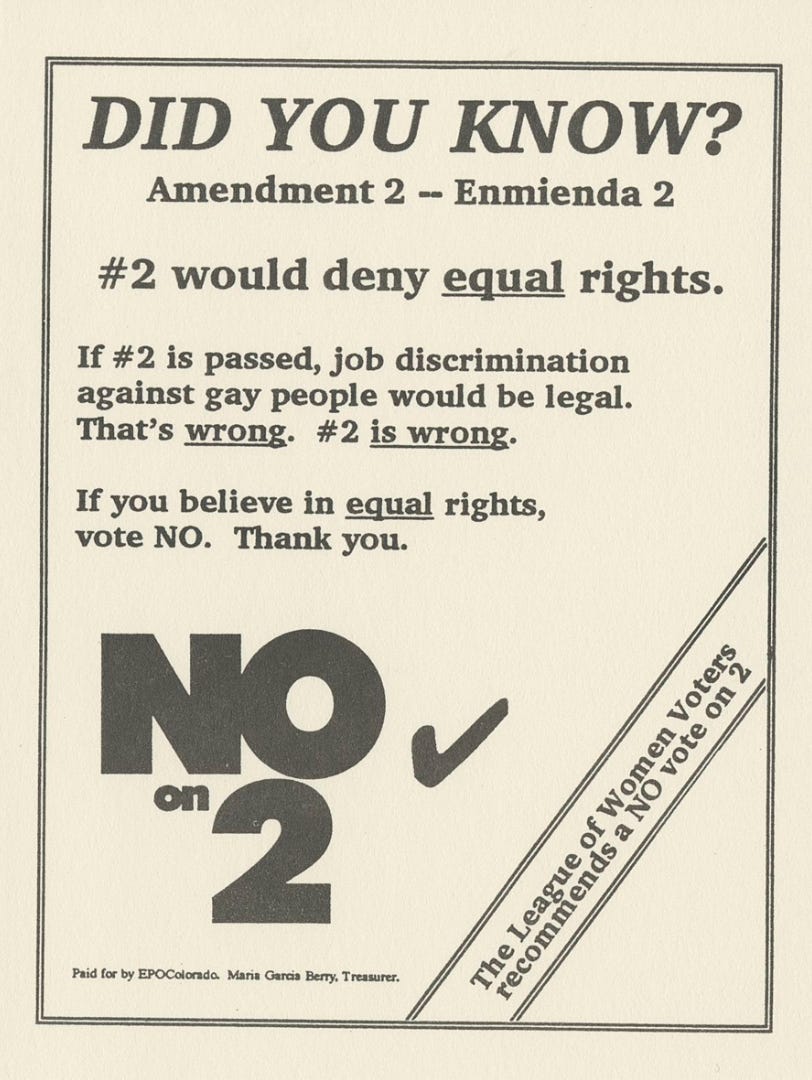
Coming out under these circumstances provided further lessons; lessons about identity and how sometimes, whether we like it or not, identities need to be fought for. But it’s more nuanced than that. I remember during all that political upheaval I was told “what we do with our bodies is political, to hold your boyfriend’s hand is political.” And while that was true at the time (and still is depending on where you are when holding it), but it’s more than just political; it’s also personal, private, relational, and intimate. Later I was to learn that while identities at one time may be liberating, at others, they can be limiting.
How much do personal experiences inform the work of the psychotherapist
An interesting line of questioning developed when Shekhar asked if my personal experiences gave me the insight required to be better able to help my clients - and the answer is, as usual, a nuanced yes and no. I do not believe that therapists need to share the same experiences as their clients in order to understand them, but they can use such experiences to enable a deeper empathy with them. Even for those who share like life-events with their clients, the subjective experience of those events will always be different, so my way of dealing with a life challenge is not a map for others. However, the kinship of general life experiences as a process can be similar enough to resonate enough with others - opening a space, borne of experience, in which to explore theirs.
This came out in a surprising way in our “quickfire round” at the end when Shekhar asked me what I wish I'd known at the start of my journey that I know now. I said that people are more similar than they are different. In today’s polarised world where categories of identity and life experience seem to divide people more than they bring them together, I think this is a crucial insight.
It is no coincidence that we kept returning the idea that has informed my work for two decades - the importance of mutual authentic recognition - the capacity for human beings to see each other, accept each other, and love each other in all their complexity, difference and sameness - to be truly seen, flaws and all, by another mind.
We live in a world where we have exchanged recognition for its lighter version, validation. On social media we get validation through likes, followers, reposts, thumbs-ups, and how many readers we have on Substack; recognition is a deeper form of being known. I’ve described the difference frequently where validation is like junk food and authentic recognition is a nutritional meal: one lights up the same circuits for a moment and leaves you hungrier, the other actually nourishes you.
Sitting in the interviewee’s chair I was reminded again of what it’s like to be the subject of someone else’s curiosity to know me at such a deep level. Shekhar’s warmth, and the intimacy he built in the room, overrode my inhibition and my therapist’s instinct for privacy, and made me forget the audience entirely. Naturally, therapy offers a similar experience, and beneficially with an audience of one who will protect your story with confidentiality.
Exposed, yes. Regretful? No.
Did I walk away feeling exposed? Yes. Was I reluctant to share it? Also yes — my instinct for privacy is not just temperament, it’s the discipline of the job. My answers were roughshod in places and less eloquent than I’d like, precisely because I hadn’t prepared to talk about myself at all.
I’ve been sitting with these thoughts for a few weeks now. So much of our public life is amplified, not incidentally, by the very machines I’d come to discuss. But this public exposure is so often partial, geared towards the validation engine of what gets engaged with. We perform expertise because the medium selects for it. Which is also why I’m sceptical, as I told Shekhar, that an AI could do the deeper part of this work: it can generate fluent validation all day, but recognition, the genuine will to understand someone else, to hope for their healing and wellbeing, is something that a machine without a self simply can’t do. What he coaxed out of me was very much myself, the persona reduced. This isn’t to reduce my expertise, but to bear my uncertainty, to capture a person thinking in real-time rather than transmitting a polished perspective. It made me uncomfortable, but I hope it made a connection.
So here it is, fully exposed, as it were — beard and all, or rather not. Fortunately, beards grow back. And fortunately, you can listen rather than watch, on your podcast platform of choice, on Tomorrow, Today with Shekhar Natarajan.
Dr Aaron Balick is a psychotherapist, author, and keynote speaker who applies depth psychology and psychoanalytic thinking to technology, AI, social media, and modern culture. He is the author of The Psychodynamics of Social Networking and writes a monthly psychology column for GQ. His newsletter Depth Psychology in the Digital Age is published on Substack.
An amazing interview, Aaron (I had to watch the video in three parts as there is so much to take in!) and so refreshingly human! I was fascinated to hear Shekhar's summary of his own thoughts at the end about AI and whether it can ever replicate/replace the human therapist. Thank you for your amazing openness and honesty here. So much food for thought, and I really recommend watching the whole thing as it twists and turns in such unexpected ways.