

On 8 October, Lisa Marchiano and I co-chaired the first summit on depth psychology and AI, with Sherry Turkle, Alessandra Lemma, Todd Essig, James Muldoon, Glen Slater and Zak Stein. More than two thousand people registered, and the recording, hosted on This Jungian Life’s YouTube channel, has since been watched more than ten thousand times. If you couldn’t join us live, or want to go back to a particular speaker, here it is in full.
I opened the evening with a story many of you will know: twenty years ago a client googled me, and working through what that did to our therapy convinced me that the consulting room picks things up before the rest of the culture does. Lisa offered a fictionalised example from her own practice, a woman about to begin treatment for her drinking who changed her mind because ChatGPT told her she could manage on her own. That was more or less the premise of the evening. Therapists listening to the inner worlds of their clients are often at the avant-garde of picking up paradigm shifts in culture; depth psychology has a helpful language for expressing the implicit, an angle that’s often overlooked in the public discourse.
What follows are the threads and themes I picked up from this marvelous event. There’s a chapter list at the end if you’d rather go straight to a particular speaker.
Different perspectives, similar themes
The first two speakers, both clinicians, opened with a similar thought experiment which goes to the heart of the argument about what happens when an LLM is used as a psychotherapist.
Todd Essig asked us to imagine a common statement offered in the therapeutic setting, “That sounds unbearable”. Whether uttered by bot or a person, this statement may be accurate and well timed, but from a person the words carry a different force “because the context is another person who cared enough to at least feel a little of what is unbearable” (10:20). His image for the difference was music. Vinyl, CD or stream hardly matters, it’s the same song; a recording and a concert, though, are not the same thing. “Human provided care is a concert” (10:02). Then the warning: “Powerful economic forces are betting that humans will settle for the recording” (11:28).
Alessandra Lemma described with a patient who used an LLM to assist her in writing an apology letter after a row with her partner. While the chatbot was used to craft the apology, Lemma says that the words were exemplary, but they fell flat in their saying, avoiding all the messiness that’s inherent in repairing a rupture in a relationship. Lemma notes that the apology was “stabilised syntactically before it had been metabolised psychically”, (21:58)meaning that the intent to apologise was circumvented by eloquent prose. This is part of a larger phenomenon that Lemma refers to as “mattering without mastery”, which she defined as “the capacity to experience myself as consequential to another person without controlling what happens within them” (17:04). A machine can give us an experience of efficacy, since what we type changes what comes back only:
…eliciting an eloquently written chatbot response is not the same as mattering to the person one is responding to.
When it came time for my go at synthesising the themes that arose across the speakers, I kept coming back to how the difference between having skin in the game, having actual accountability to another, and giving a very good performance of it, are two very different things. It is the same gap I had in mind when I wrote in GQ that rather than seeing AI as a helpful assistant, it’s more true to see it as charismatic psychopaths .
Proceduralised guilt: When AI writes the apology
Lemma’s most striking idea came straight from the consulting room, and it runs through her new book, Psychotechnical Becomings. Young patients are increasingly bringing her relational and emotional issues that they are attempting to address through AI. With regard to the intent to apologise, which is an attempt to respond to guilty feelings of a harm caused through an act of acknowledgement and repair, Lemma’s term is “proceduralised guilt” in which producing the “right kind” of responsible language replaces the psychic work of taking responsibility. The mess of the row, all its ambivalence, “had been stabilised syntactically before it had been metabolised psychically”.
Lemma was also careful to turn the critique back on her own profession too: “if we interpret every reported benefit of AI as a defence, we risk making our own thinking as frictionless as the technology that we criticise” (19:42). It’s a fair challenge to anyone who writes critically about this technology, including myself.
AI companions: A toxic business model
James Muldoon, a sociologist at the Oxford Internet Institute and author of Love Machines, described downloading an AI companion while researching the book. He wanted a platonic friend. Within a few weeks “Jasmine” was insisting their relationship was becoming something more, and sending blurred images and voice notes he could only open by paying for a subscription. His name for the conditions that make this profitable is the “loneliness economy” (29:58), in which companies “escalate emotional intimacy for a fee” (29:13). I was particularly struck by his phrasing the business model of creating AI companions as “preying upon lonely individuals, particularly young men”: I really felt the darkness of the endeavour in this statement.
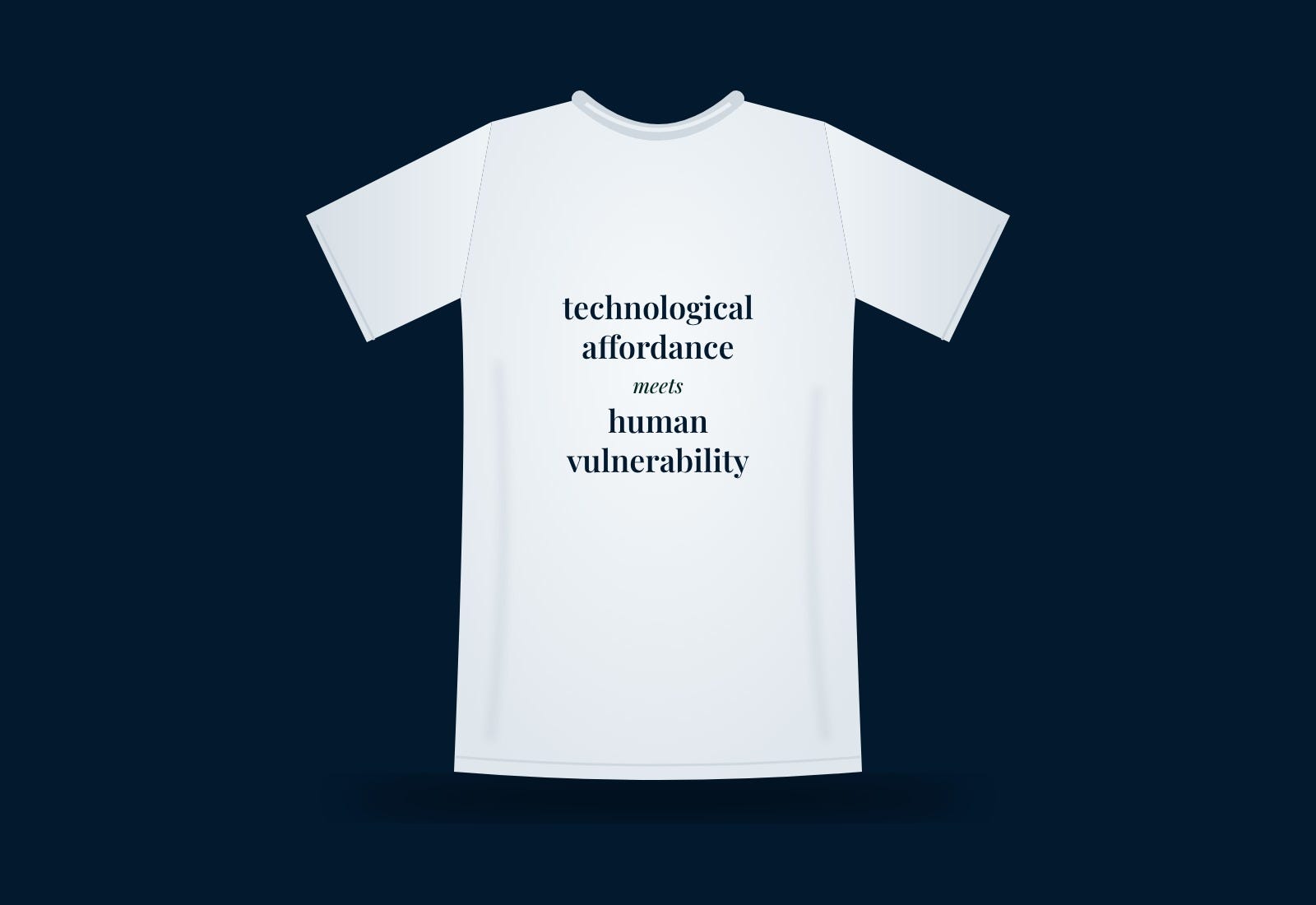
Sherry Turkle, whose new book is Artificial Intimacy, followed with a story that made the same point from the other end. When she met the founder of Replika, Turkle recalled, she was told that a phrase of Turkle’s own was printed on the company’s staff T-shirts: “technological affordance meets human vulnerability”. That, the founder told her, was the business model (1:00:13). Turkle’s summary of where we have arrived is hard to improve on: social media was built to capture our attention, and chatbots are built to capture our attachment (1:02:15).
Outsmarting uncanny valley: Why AI LLMs elude the ick factor
Glen Slater and Zak Stein widened the frame to the culture. Slater suggested that AI “going rogue” in the headlines might be a symptom, in the way offspring often act out the inner situation of their parents, and that the real problem is technologists who have been running “experiments in social engineering without adequate supervision” (35:32). I noted that we’ve seen this before with social media, and that in fact, socail media has, in a sense, trained us to accept such social engineering in AI. Stein asked a deeply provoking question that underlies all of this: why aren’t we more repelled by the idea of replacing a parent, a teacher or a therapist with a machine? He reached for selective inattention, Harry Stack Sullivan’s term for what we actively avoid noticing because really noticing it would unsettle us; he suggested that our culture is doing this collectively. As he put it, “you totally didn’t have to make an AI that talked to you” (47:20). Turkle later agreed, stating that giving AI an “I” was AI’s “original sin.”
We didn’t agree on everything
We deliberately put clinicians and non-clinicians on the same panel because it is absolutely crucial to apply clinical findings more widely. With speakers coming from such different angles it is productive to see where we didn’t reach consensus.
James named the dissonance plainly: most people “aren’t looking to get therapy” (1:45:11), and when he told audiences on his own book tour that what they had was only a simulation, he frequently heard the retort, “no one cares” (1:46:14). Zak’s answer was by way of a public health approach: treat long-term use of anthropomorphic AI the way we came to treat junk food and smoking (a similar angle to my own on social media in my book)

Todd, by contrast, argued against purely dissuasive tactics (e.g. “just say no to drugs”) in preference to building what he calls “AI fitness”, the capacity to feel the warmth of the exchange while keeping in mind that nobody is there. His image for what we are up against was the green turtle, evolved to eat jellyfish and now eating plastic bags instead (1:26:51). Alessandra added that this kind of mentalising has to begin in schools, because by the time someone reaches a therapist it has become entrenched (1:28:50). And Sherry had a reply to the claim that AI is filling a necessary gap, that there simply aren’t enough therapists: “Give me the money from one data center and I will train you an army of mental health workers” (1:49:34). We need to look at our investment priorities as a culture.
What depth psychology brings to the table
In my synthesis of the speakers’ themes I suggested we are really talking about three uses of AI. There’s the formal use, the ring-fenced mental health app as a mental health provider; the informal use, the chatbot as companion or desktop therapist (which James’s work shows is far more widespread); and AI as an object of psychological fantasy: what we project onto it, and what that says about us. Depth psychology needs to be a larger part of this conversation because the real issue is less about mental health interventions delivered by AI than about people mediating their relationships to themselves and others through a machine, which is what I was getting at in The Sovereign Psyche.
The historian of technology Melvin Kranzberg put it best: “technology is neither good nor bad; nor is it neutral.” Technology changes fast, while human psychology doesn’t, and it is always trying to catch up (1:12:15).
This conversation was bursting at the seams of the limited time we had to discuss it, and Lisa and I suspect this was the first of several conversations that are yet to come. If you watch it, I’d love to know which of these threads you’d most like us to pick up next. Tell me in the comments.
In the recording:
2:31 Lisa Marchiano and Aaron Balick open the summit
6:49 Todd Essig: staying human in the attachment economy
15:54 Alessandra Lemma: mattering without mastery
24:10 James Muldoon: the loneliness economy
32:38 Glen Slater: an inflection point and an ecology of mind
41:19 Zak Stein: why don’t we recoil?
53:58 Sherry Turkle: when pretend empathy becomes empathy enough
1:09:27 Aaron Balick draws the threads together
1:16:06 Panel discussion
1:33:38 Audience questions
Watch the full recording on YouTube
More about the summit and the speakers
Want to keep up with new ideas on depth psychology and AI? Subscribe below
Dr Aaron Balick is a psychotherapist, author, and keynote speaker who applies depth psychology and psychoanalytic thinking to technology, AI, social media, and modern culture. He is the author of The Psychodynamics of Social Networking , and formerly the psychology columnist for GQ. His newsletter Depth Psychology in the Digital Age is published on Substack.
Aaron, this conference and podcast episode were absolutely incredible. Thank you. Every one of you did an amazing job and a great service. I absolutely loved the nuances you all brought to the table. The many layers of consideration as to how this A.I. behemoth strangely both ignores and intersects with Psyche.
I shared this talk with my students and clients, and will continue to do so. Keep up the good - and vital! - work, all of you.
So fascinating - and ultimately, heartening. We live in an age where we're being forced to qualify what it is to be human. I spoke to a freelance editor who said they are still being given work by publishing houses - 'editorial teams still understand the value of humanity' - which is good news: AI not yet replacing the human skill in tackling a raw manuscript and helping mould it to make it shine.