


In a follow up to Psychoanalysing Half Man’s Disturbing Finale in GQ, Psychotherapist and author Dr. Aaron Balick argues that Half Man isn't about toxic masculinity; it's a public dream that resists interpretation — and Gadd's insistence that he doesn't know what he's made is the most psychoanalytic thing about him.
Half Man starts out as uncompromising realism slowly starts to unravel, and by the time episode four finishes you know something else is going on entirely. This is why I argued in my column for GQ that, because of the way it is structured, abandoning the rules of time and logic, it can be analysed like a dream. This forces us to feel our way through it rather than passively follow along a rational linear narrative.
In a series of interviews, Richard Gadd insists Half Man isn’t a thematic follow-up to Baby Reindeer, nor is it a commentary on “toxic masculinity”; you get the sense that whatever it is about, it’s something he can’t exactly put his finger on. And this is exactly why it works. In this extended version of my article Psychoanalysing Half Man’s Disturbing Finale , I’ll be explaining why.
Streaming is Dreaming
In my original article I focused on the dreamlike structure and style of Half Man; the out-of-sequence wedding reception scenes that ultimately never seem to fit together; the odd slow-motion opening to episode four; and the scene in the empty hospital room, where the lads’ fighting and resulting clanging of bedpans fails to attract a single member of staff. I don’t think they ran out of budget for extras and it’s not an oversight either, it’s a conscious break with realism.
The stretching of realism to breaking point doesn’t end with structure and style, but also what Gadd asks us to believe in relation to plot and character. In episode four we leave Niall a wrecked version of a man, yet at the start of episode five we are expected to believe that he has not only finished his book but seen it received as “a modern masterpiece”; that he is living in a world of middle-class heteronormativity (however thin the veneer) and married to what seems to be the perfect woman (Ava, what were you thinking?) and responsible for not one but two near-miraculous conceptions? That Ruben, sharp as nails with a preternatural ability to read a room, never once cottons on to the infidelity unfolding under his nose? And perhaps the biggest leap of faith of all, that sweet Alby would actually choose to marry Niall?
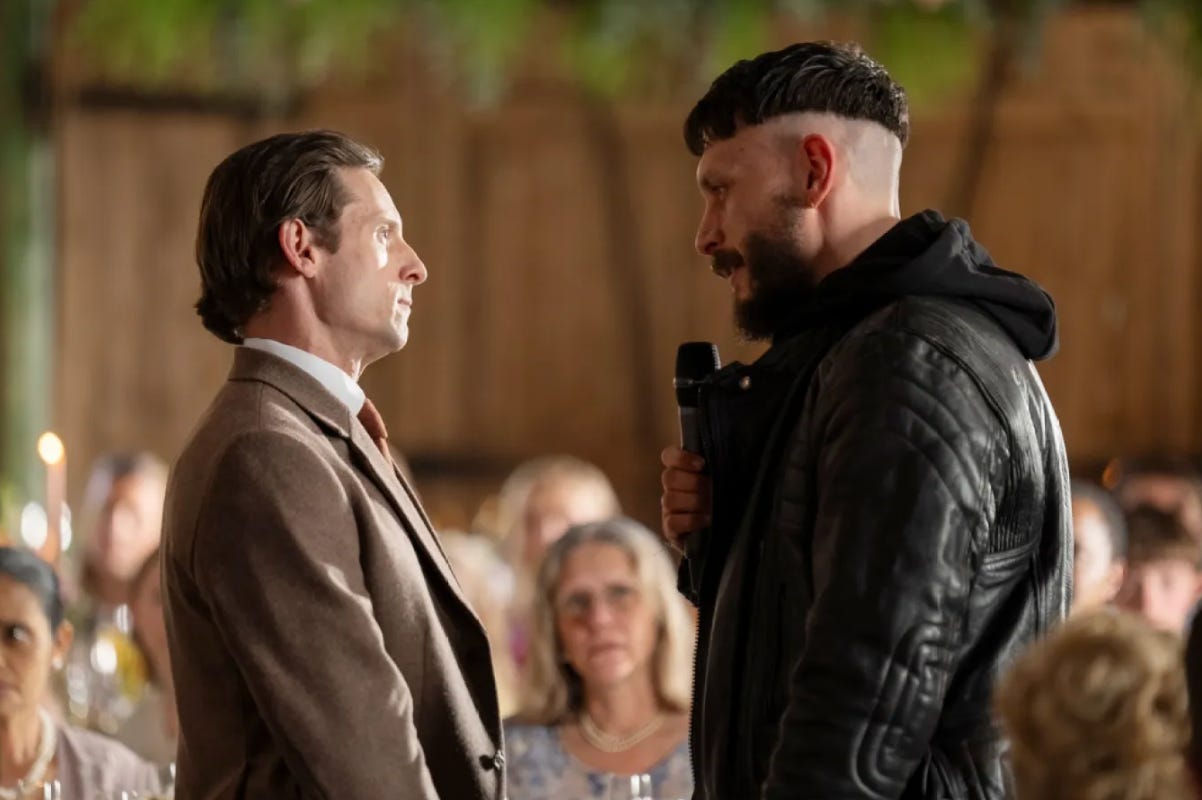
These seem like plot holes you could drive a combine harvester through – but only if you hold fast to the idea that this is a standard drama. Dreams have holes too, but they are not mistakes, they are embedded into the very texture of dreaming. That’s because dreams are about as close as we can get to the unconscious, the very reason Freud called them “the royal road to the unconscious.” He explained that the unconscious material that feeds our dreams, the dream’s “latent content” is unavailable to consciousness due to repression. When this material rises up during sleep, this material gets censored on the way up in order to preserve our sleep from the potentially upsetting unconscious material. It’s the censorship that twists and distorts the original dream material into the surreal mess we usually remember.
The dream itself is the “manifest content” – it does not argue its reasons or meanings, it simply asserts them, and the sleeping mind plays them out. You do not pause, mid-dream, to wonder why you’re sitting on your bed in your childhood bedroom speaking to Jennifer Aniston when suddenly your boss walks in naked. It is only on waking that the architecture seems to collapse into nonsense. Gadd’s achievement in Half Man is the slow way in which reality starts to fracture and we start to question if we are in some kind of a dream. The odd structure and style, the implausibilities of plot and character aren’t errors, they are craft. They are how he tells us, without telling us, what kind of object we are actually watching. But to add one other layer to the mystery, I’m not sure he knows either.
The “Bambi” clue: The deerest Freudian slip

Freud famously said that “the ego is not the master of its own house”: the same could be said of creators and their creations. While I would never psychoanalyse a person without their consent (let alone having never met them), I think I can harmlessly make some psychoanalytic inferences about Gadd’s process in creating Half Man by drawing on what’s in the public domain. The most interesting source I came across is his interview with David Marchese for The New York Times where Marchese links Gadd’s two television creations:
“What Half Man shares with its predecessor [Baby Reindeer] is a brutally unflinching exploration of sexual confusion, tortured masculinity, emotional abuse and the impact of trauma … Those are all issues that Gadd himself is still trying to understand both in his art and, to varying degrees of success, his life.”
Marchese is pointing to how artistic practices can have both creative and therapeutic value as an attempt to make sense of something that cannot fully be made sense of. This is something I remarked on in my analysis of Baby Reindeer at the time, drawing on Jung’s approach to his autobiography Memories, Dreams, Reflections as a “personal myth” rather than an objective log of events. It could be argued that Baby Reindeer as a creative act is more straightforward as a creative endeavour because it is based on Gadd’s personal experiences, he has his memory to draw on. But Half Man, being fiction, offers no such guidance in memory – so Gadd would have to draw on something more.
Marchese’s assumption that the two narratives were related seems obvious. I made the same assumption myself. The first time Ruben called his doe-eyed Niall, “Bambi” I laughed out loud - a baby dear! I thought Gadd’s clever wink to his earlier work was delightful. Yet Gadd denies any intention in the interview; in fact, he argues that any link of the kind, would be impossible because the script for Half Man with its Bambi reference was written before Baby Reindeer. When Marchese hears this he laughs and says, “So I think there’s something [about Bambi] floating about your mind.” Like a good psychoanalyst, he isn’t wrong. “Bambi” as an important clue to the mind behind the show is not to be dismissed, but to be treated more like a Freudian slip – full of meaning.
The 'Bambi' nickname is Gadd's Freudian slip: a Baby Reindeer reference he didn't consciously place but couldn't keep out.
I believe Gadd when he says this wasn’t a conscious choice, but I gather from listening to this conversation that his unconscious, sneaky little bugger that it is, was dutifully working outside his awareness on resonant themes that would arise in both scripts but in different forms. The first form becomes a fictionalised memoir, the second a dream-like work of fiction. When you throw Jung into the mix, you gain access not to just the personal unconscious as the dream material, but the collective unconscious as well.
Interpreting dreams isn’t quite the same thing as interpreting streams
If you accept that the show works like a dream, that doesn’t mean you can interpret it like one. To even start to interpret a dream you need to speak to the dreamer; and invariably dreamers don’t know the meaning of their own dreams. But there is a bigger question here, “who is dreaming it?” Gadd may be the creator, but it takes a team to produce a television series, a broadcaster to stream it, and a receptive society into which it can be released.
Gadd himself struggles to say what it means, at least not fully, and this turns out to be one of the most beautiful psychoanalytic things about him! He allows the process to roll out as it is, kind of raw, making it so much more than being about confining conceptual categories by saying “it’s about abuse, or trauma, or toxic masculinity.” He keeps insisting, in interview after interview, that he does not entirely know what he has made.
“The ego is not the master of his own house.” - Sigmund Freud
Pressed by Marchese on whether the show answers the question of what it means to be a man, Gadd demurs: the work poses questions, he says, it doesn’t resolve them. He even has a theory, which he describes almost shyly, that an artist doesn’t choose their material so much as the material chooses them. Jung also suggested that genuinely visionary work doesn’t get manufactured by the artist’s conscious intentions; it arrives through them via the “transcendental function” from somewhere the ego doesn’t govern: the artist is as much a witness as its author. For me, Bambi, the baby reindeer that he didn’t mean to put there is the proof. The work knew before he did.
Dreaming in streaming
The mythologist Joseph Campbell is known for his maxim that “the myth is the public dream and the dream is the private myth.” But the longer quote is more helpful here:
“… a dream is a personal experience of that deep, dark ground that is the support of our conscious lives, and a myth is the society’s dream. The myth is the public dream and the dream is the private myth. If your private myth, your dream, happens to coincide with that of the society, you are in good accord with your group. If it isn’t, you’ve got an adventure in the dark forest ahead of you.” - from The Power of Myth.
Gadd has done something extraordinarily unusual in having done both – Baby Reindeer was a private myth made public and Half Man is a public dream made to stream. As of this morning, millions of people have now shared the same unsettling dream. They have argued about it, decoded it, and posted their thoughts online (or is it just me?). Gadd’s personal myth has gone collective, which is precisely the journey Campbell describes, running in reverse. Whether Gadd himself feels it happens to have “coincided with that of society” will determine whether or not he has an adventure in the dark forest ahead of him. I think it is coincident – but I also think we all have that dark journey ahead.

The dark journey is important for all of us, because it requires us to be lost for a while in order to find our bearings – it requires us not to have answers that are nicely tied up. While Freud was more conscientious than most to want to tie things up with answers, plunging into the great unconscious to do so, admitted:
“There is often a passage in even the most thoroughly interpreted dream which has to be left obscure; this is because we become aware during the work of interpretation that at that point there is a tangle of dream-thoughts which cannot be unravelled and which moreover adds nothing to our knowledge of the content of the dream. This is the dream’s navel, the spot where it reaches down into the unknown” - Sigmund Freud
Gadd, in keeping faith with the dissembling nature of his latest beast seems to understand this, whether consciously or not. This is why simple “aboutism” explanations like, “it’s about trauma” or “it’s about toxic masculinity” fall so flat. It is about these things, but so much more too. A public dream is not a leaflet, it does not deliver a simple message. Trauma is a good example of this. As I described in the original piece, Gadd presents us with material that is very difficult to consume, particularly the complexity of trauma. We all know that trauma is a harm, but few have been exposed to the idea that the trauma of sexual abuse is sometimes fused with other feelings like closeness and desire - which is the very reason why closeness and desire can be so scary and dangerous to those who have experienced this kind of abuse.
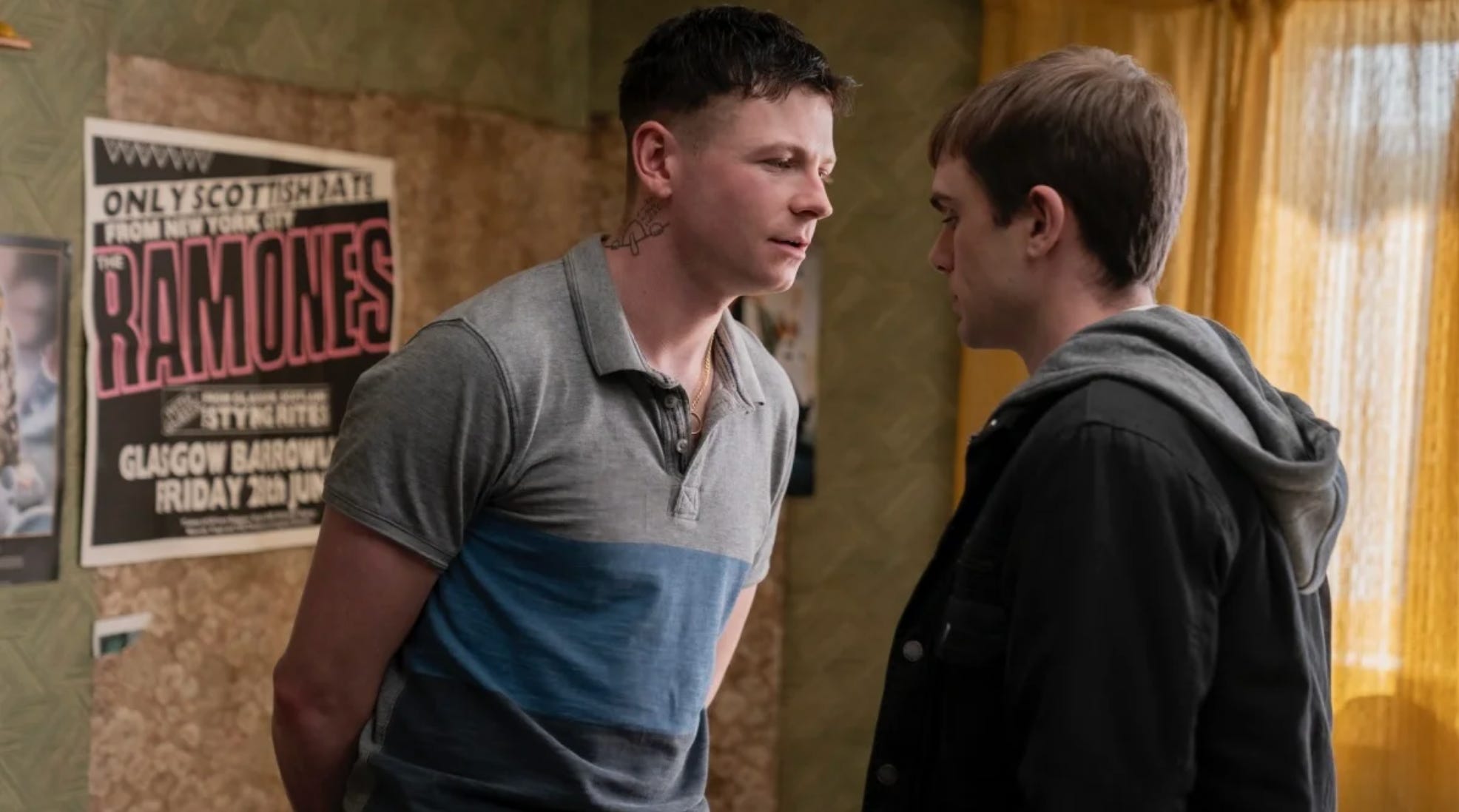
Gadd says he likes his characters to remain inconsistent, doing and saying things that don’t add up, that refuse to cohere into a clean diagnosis. This really runs counter-current to society and the way our culture seeks to capture suffering and diagnose trauma with neat labels according to which one builds an identity or finds a manualised treatment. The “therapy myth” has much to answer for too, the idea that if we just build a causal chain, reach a breakthrough, and understand it all, we’ll be sorted.
Much of the discomfort people report when watching Half Man is about being denied a resolution — contrary to what the standardised entertainment format, a mirror of our culture, has trained us to expect. We keep waiting for the scene that explains it all and makes it bearable, and Gadd, faithful to the logic of dreams and to the truth of trauma, declines to supply it. Resisting the gravitational pull to a definitive explanation is courageous and bold – Gadd’s contrarianism in this approach, I imagine, is his dark forest.
Society wants answers, not dreams — but society needs to learn to live with the uncertainty of the dream
We live in a culture that cannot tolerate the unresolved. Every film now trails its own commentary (present company included); every scene generates a “what this really means” explainer; every artist is expected to step out from behind the work and account for it, ideally in a format optimised for sharing. The unspoken assumption is that the maker should know, that they are the final authority on meaning: but the artist is not the master of his own palette.
Gadd hands us the dream but declines to interpret it. This is not clever marketing; it’s because he genuinely cannot; to his enormous credit, he keeps saying so. This leaves the rest of us with a similar task. Should we decode the dream into a clean and tidy narrative, explain away its characters with a neat psychiatric label, diagnose it as a statement on a single social issue, we strip that dream of its magic. Instead Gadd asks us to resist the itch to explain a thing rather than fully feel it (however raw), and to stay with what refuses to neatly resolve so we can let it remain an open question.
Gadd can’t tell us what Half Man means. He shouldn’t be able to. That’s the point. He gave us the dream, now it’s up to us.
If this resonated with you, please forward it to someone who watched Half Man.
Dr Aaron Balick is a psychotherapist, author, and keynote speaker who applies depth psychology and psychoanalytic thinking to technology, AI, social media, and modern culture. He is the author of The Psychodynamics of Social Networking and writes a monthly psychology column for GQ. His newsletter Depth Psychology in the Digital Age is published on Substack.
Interesting take, thx!